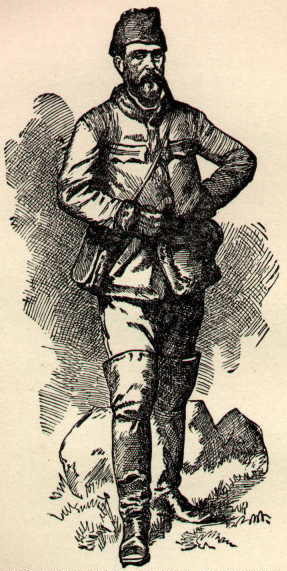
Janarius Aloysius McGahan
Дженюариъс Алойшиъс Макгахан
Януариус Макгахан (Януарий А. Макгахан)
(1844—1878)
|
Janarius Aloysius McGahanДженюариъс Алойшиъс Макгахан (1844—1878) |


About the book "American Witness" - a publication of Januarius MacGahan’s coverage of the crushing of the April Uprising of the Bulgarians by the Ottoman Empire in 1876.
During his short life of only 34 years, US journalist MacGahan turned into one of the most prominent military correspondents of the 19th century. He covered Russia’s penetration into Central Asia, the search for Franklin’s lost expedition in Antarctica, the French Prussian and the Russo-Turkish wars. As it is known, the Russo-Turkish war partly a result of the Turkish atrocities in the crushing of the April Uprising in Bulgaria. MacGahan’s dispatches spread the truth about the inhuman cruelty of the Turks all over the world. Archibald Forbes, the great English writer and correspondent, who rode by his side, in an article on MacGahan pays this tribute to his great services:
"MacGahan's work in the exposures of the Turkish atrocities in Bulgaria, which he carried out so thoroughly and effectively in 1876, produced very remarkable results. Regarded simply on its literary merits, there is nothing I know of to excel it in vividness, in pathos, in a burning earnestness, in a glow of conviction that fires from the heart to the heart. His letters stirred Mr. Gladstone into a convulsive paroxysm of burning revolt against the barbarities they described. They moved England to its very depths, and men travelling in railway carriages were to be noticed with flushed faces and moistened eyes as they read them. Lord Beaconsfield tried to whistle down the wind the awful significance of the disclosures made in those wonderful letters. The master of jeers jibed at as 'coffee-house babble,' the revelations that were making the nations to throb with indignant passion."
Januarius MacGahan’s notes caused an outcry and were published in all big newspapers in the United Kingdom, France and the US, and later on in Russia as well.
After the Russo-Turkish war of 1877-78, which resulted in Bulgaria’s liberation, this country’s big statesman Stefan Stambolov translated them into Bulgarian and published them in 1880.
In 1997, Bulgarian historian Teodor Dimitrov, who lives in Geneva, published the second edition of the notes, adding biographical data about MacGahan. So "American Witness" is the notes’ third edition in this country. Macgahan’s dispatches for British "Daily News" won the Bulgarians the support of personalities like Oscar Wilde and Charles Darwin, Victor Hugo and Dostoyevski. Said Luko Zahariev from "Strelets" publishing house:
"Obviously MacGahan was an exceptionally brave man to oppose two big empires simultaneously, the Ottoman and the British. The first defended the murderers and the second did not want to have the status quo in the Balkans changed. This is how MacGahan happened to challenge directly Britain’s Prime Minister at that time, Disraeli. Here is what he wrote about him: "In Mr. Disraeli’s view, the big crime is not in the murdering of thousands and thousands of innocent people, but in the fact that the newspapers wrote that 30,000 were killed, when the real number was "only" 25,000. The insulting mistake consisted not in the fact that thousands of young children have been slaughtered, but in writing that their number was 1,000 when actually they were 999!" MacGahan indeed used devastating irony to defend justice and truth. In my opinion, he is one of the great spirits of the 19th century, Luko Zahariev contends. It is not incidentally then, that in 1976, when commemorating the 100th anniversary of the April Uprising, the citizens of Batak placed his statue in the centre of their town," Luko Zahariev said in conclusion.
During the Russo-Turkish war, MacGahan visited Bulgaria again and everywhere he was hailed as a liberator and deliverer; the grateful people ran after him as he rode through the streets of the towns and villages of this country, kissing his boots, saddle, bridle, and even the little pet horse that he rode. Archibald Forbes, MacGahan’s companion in his travels says the grateful and affectionate demonstrations of the people of Bulgaria towards MacGahan, surpassed anything of the kind he ever saw or imagined.
Shortly after the Russo-Turkish war, MacGahan died of typhus in Istanbul. Later his body was taken to the cemetery of Maplewood in New Lexington, Ohio. The inscription on his tombstone reads: "MacGahan, Liberator of Bulgaria".
© Bulgarian National Radio
www.bnr.bg
When I was invited to speak to an audience
in the highly prestigious University of Toronto, my first thought was that it has to be a grand commemorative speech. But then I realized that in the audience may be people, who
may not be too familiar with the fine points of the Bulgarian history, due to the fact that they have not received their education in Bulgaria, or because they simply are not
historians. Therefore I decided to speak in detail about the events leading to the signing of the treaty of San Stefano on March 3rd, 1878, the signing of the treaty that
unofficially granted Bulgaria its independence from the Ottoman Empire.
Today many people in Bulgaria are asking the question – why is the signing of this particular treaty such an important event in the history of Bulgaria. Why have we chosen this specific date to be our national day? Why have we not chosen, for instance September 6th, 1885, the day of the unification of North and South Bulgaria, or September 22nd, 1908, the date Prince Ferdinand officially declared the independence of Bulgaria from the Ottoman Empire?
Since the demise of the second Bulgarian kingdom in 1396 under the relentless expansion of the Ottoman Empire, the Bulgarian people have endured a long Odyssey, at the end of which they again became people with their own national identity and their own country. The first steps on the long road towards national rediscovery lead from the work of the Monk Paisii and his “History of the Bulgarian people”, through the struggle for an independent Bulgarian church and culminated in the organized political, cultural and armed struggle for national independence.
March 3rd is celebrated because it is the beginning of the road leading to the establishment of sovereign Bulgarian state.
In the mid-nineteenth century Bulgarian national movement is faced with two possibilities. The first is the achievement of independence, by legal means and reforms, through the continuous expansion, of the political autonomy of Bulgaria within the framework of the Ottoman Empire. In this scenario, the use of violence and unnecessary bloodshed is avoided, and at the same time the integrity of the Bulgarian ethnic territories is guaranteed. Unfortunately, this also means that the date of achieving independence can be delayed indefinitely.
The other course of action relies on massive armed rebellion, the aftermath of which would bring a political solution to the Bulgarian Question. It has one important drawback – the plan does not guarantee the integrity of the Bulgarian ethnic territories, as the final phase does require intervention of the Great Powers. In essence, the fate of Bulgaria depends on their good will, and even more important, on their regional interests. This radical approach means also fighting and countless casualties, but makes the goal of liberation tangible.
For the Bulgarian society, longing for freedom, these arguments are not a deterrent to choosing the second option. In 1876, the April rebellion erupts. It is defeated in blood, but it achieves the expected political effect. The lives of 30 000 people are the price the Bulgarian people pay for the attention of the world to be focused on the events occurring in Bulgaria during April and May of 1876. The brightest minds of the time voice their support of the Bulgarian cause – Victor Hugo, Charles Darwin, Oscar Wilde, Leo Tolstoy, Dostoyevski etc. This provided Russia with a pretext to declare war on Ottoman Empire on April 24, 1877.
In the course of two centuries - 18th and 19th, the Russian tzars fight thirteen wars with Turkey, which have one thing in common – they are governed by the goal of gaining control of the Balkans and the straights between Europe and Asia Minor. For the Russian monarchs, the road for establishing Russia as world power always leads through the Bosporus and the Dardanelle’s, toward the Aegean and Mediterranean seas, and the Oceans. For this purpose, they systematically build the reputation of Russia as guardian and defender of the Balkan’s Christians and all Slavs within the Ottoman Empire. The influence Russia is gaining grows in proportion to the trust of the people of the Balkans in its mission of liberation.
The thirteenth, “our” war, between Russia and the Ottoman Empire, is different from its predecessors. It is not motivated by the previous policy of expansion by force and Russian diplomats make real efforts to avoid it.
Our interests – writes the Russian Prime Minister Gorchakov – in this particular moment ask for the preservation, not the break up of the Ottoman Empire. We will do all we can to help the Christian people of the Balkans, through political pressure of the Supreme Porte, but will not, in any instance, approve off, nor tolerate any uprisings against their rightful ruler – the Sultan”
But in 1876, not only Bulgaria, but also Bosnia and Herzegovina are engulfed in the flames of rebellion. In defense of the people of Bosnia and Herzegovina, the Kingdom of Serbia and Montenegro declares war on the Ottoman Empire. The Eastern Crisis erupts again with new strength. The Russian diplomacy undertakes very active steps to defuse the situation. The result is an Ambassadorial conference in Istanbul in the beginning of 1877 and the signing of the London Accord, which the Sultan categorically refuses to accept.
This put Russia in real danger of permanently loosing its credibility in front of the Balkan’s Christians, if it fails to act in this very critical moment. The price of inaction and passive disinterest would be the loss of the powerful position it has gained through its many military campaigns against the Turks. This could be clearly seen in the words of the War Minister Milyutin in a special memo to Tsar Alexander II:
”The outcome of the Istanbul conference, clearly indicates that multilateral influence of Europe over Turkey is out of the question. The passive agreement of the European powers sacrifices the fate of the Balkan Christians. But we should not hide from ourselves the importance and the danger of such course of action. The impotence of combined European efforts can only encourage Turkey, and turn this weak state in great weapon against our interests. We can not tolerate the constant humiliation of our pride and the erosion of our material interests, until the last trace of influence we have in the Balkans is gone.”
After stormy debates in the Imperial Council, the arguments of Milyutin finally win, and on April 12, 1877, Russia declares war on Turkey.
In only 8 months the Russian forces manage to drive the Turks from all Bulgarian territories and reach Constantinople. On the memorable for all Bulgarians date of March 3rd, 1878, in the small village of San Stefano, 12 kilometers from Istanbul, the peace treaty between Russia, and its allies – Rumania and Serbia and Montenegro, and Turkey, is signed. Points 6 through 11 in this treaty cover the agreements related to the solution of the Bulgarian Question. Bulgaria is to be a vassal princedom, which pays tribute (taxes) to the Sultan. The principality must have a Christian as a ruler and its own military. The borders are identical with the borders of the Bulgarian Exarchate, which are established by Sultan’s Ferman from 1870, when the Exarchate achieved its independence. These borders include Northern Bulgaria (Misia) without North Dobrudja, which is given to Rumania, the whole of Trace, without the regions of Gumurdjina and Edrine, and Macedonia without the city of Thessalonica, and the Mount Athon Peninsula.
In the end, all this remains only on paper. Shortly before the signing of the treaty, the Russian Ambassador in Constantinople, Count Ignatiev, who single-handedly drafted the treaty documents, receives secret encoded telegram from the Prime Minister, Gorchakov, instructing him that the treaty has to have “simple preliminary” character:
“There would always be rift between me and Gorchakov. – writes in his diary Ignatiev – While I was waging political war for the liberation of all Slavs from Ottoman yoke, in San Petersburg Slavic lands were carelessly given away to Austria… Gorchakov was against the San Stefano peace treaty…. It seams that his ideas were reflecting the ideas of Great Britain, not ours. He ordered me, with special instructions, to give the San Stefano peace treaty preliminary character, because Austria had objections against the treaty and planed to organize Pan European Conference for finding a final solution of the Balkan Question “
The obvious conclusion is that the high level dealings of Russian diplomacy, including information about secret arrangements with Austro-Hungary and promises to Great Britain,
which could not be broken, were not for the ears of such small pawns in the Great Game, as Ambassadors.
Even the best Russian diplomat at the Time, Count Shuvalov, Ambassador
to London, did not know the whole truth. On one hand, he did know about the fact that Russia has agreed in advance to split Bulgaria in two parts. On other, that the San Stefano
Peace treaty was nothing but a diplomatic bluff, was unknown to him. He writes:
“The Peace treaty of San Stefano is a catastrophe for us… It is the biggest misunderstanding, which we could create. Now we would be forced, in front of the eyes of whole of Europe, to retreat from our positions.”
In fact, the San Stefano Peace Treaty is not a misunderstanding. It is a tactical move by the Imperial government. In a memorable letter to the Emperor (only recently discovered in the personal archives of his wife), written just before the Berlin Congress, Prime Minister Gorchakov writes:
“The internal weakness of the states does not give us grounds to believe that we can defend by force the conquests of the war. From the very beginning I was looking on the preliminary treaty with the Turks as a useful tactical step, which corresponds with the Russian strategy on the Eastern Question. Through this step, Russia once again demonstrates its good will towards the Balkan peoples, and specifically, in this case, towards the Bulgarians, and reinforces our image of the defender of their interests. Through this we will preserve our reputation as their benefactor and defender. As far as the inevitable failure of the treaty, under the pressure of the other great powers, is concerned, this will be beneficiary for us, as the influence of the others on the Balkans will be eroded while ours is increased.”
With the signing of the treaty of San Stefano, the Russian government achieves the objective set by the war. Tough and very risky, but victorious nevertheless, the war of 1877-1878 brings the highly publicized Peace Treaty of March 3rd. Russia gives abundant proof to the Bulgarian people of its good intentions and this is received with deep and sincere gratitude. There is no foreseeable way for the people of Bulgaria to know that the treaty they believed in is just a preliminary and temporary document, destined to be revised. The truth is deeply hidden by the intrigues of the high diplomacy. It is just a matter of time before the truth about the revision becomes known, but in the eyes of the Bulgarian people, all unfavorable outcomes are due to the interference of the Great Powers. Their anger and frustrations are targeted towards the adversaries of Russia – Great Britain and Austro-Hungary, while the Russian influence gains permanent hold in their collective consciousness.
The infamous, in the eyes of all Bulgarians, Berlin Congress begins its proceedings on June 13th, 1878. Among the participants are Russia, Great Britain, Austro-Hungary, France, Germany and Turkey. (The Delegations are headed respectively by Prime Minister Gorchakov, Lord Benjamin Disraeli Earl of Beaconfield, Count Andrashi, the Foreign Minister of France, Wadington, Councilor Bismarck, and representing Turkey – two pashas.)
The Berlin treaty, signed by all the dignitaries, defines the new geopolitical reality in the Balkans and establishes the Bulgarian borders. The Bulgarian lands are divided into three parts. Princedom of Bulgaria, the autonomous territory of East Roumelia and the province of Macedonia, which is returned to the Ottoman Empire.
The outcome of the Berlin Congress is a shock to all Bulgarians, but looking back in time with all the facts available to us, the outcome should not surprise us. The problems in the Balkans have never been solved with the interest of the Balkan peoples in mind. In retrospect, the Berlin treaty is not much different from the countless other diplomatic treaties, so characteristic of the Great Game played at the time. The Serbs, after two decades of armed struggle, gain an independent state, encompassing no more than one third of their ethnic territory. From 1821 to 1828, Greece is engaged in a bloody war of independence with the Turks and, in the end, only gains Attica and Peloponess as state territories, again only a third of their ethnic boundaries. Romania started its decades long struggle for independence at the time of the Greek revolt of 1821 and was not involved in armed conflicts. Vlahia and Moldova are united in an independent state after the Crimean war, and their territory only covers half the Rumanian ethnic boundaries.
The Bulgarians are no exception. They even gain more than can be expected. The borders of the Principality of Bulgaria and Eastern Roumelia incorporate close to two thirds of all Bulgarians. The two parts have different level of autonomy, but in 1885 they manage to unite into one state.
The San Stefano Peace treaty, which we celebrate, even if short lived, has its significance.
For the Bulgarians, March 3rd is a symbol of one beginning. On this date the first political step towards a sovereign Bulgarian State has been taken. Step, for which countless Bulgarian sons and daughters have sacrificed their lives. This day proved to the Bulgarian people that the sacrifices of the April uprising two years earlier were not in vain. This day proved that the lives of the 15 000 volunteers in the liberation war, were not sacrificed in vain. This lead to the Treaty of San Stefano, finally did tore down the wall that separated Bulgaria from Europe. The Treaty was the beginning of the third Bulgarian state, the state which history has fated to be on the crossroads between the West and the East, between Europe and Asia, and the crossroads where the interests of the great powers met and intertwine through history.
Dr. Zara Kostova, PhD, March, 2005
Specialist in History of the Ottoman Empire;
Author, Rulers of the Ottoman Empire, 2002;
Editor, Studia in Honorem Professoris
Verae Mutafchieva, 2000;
Editor, Macedonian Question, 2002;
Dr. Kostova has also numerous publications on the history of the Middle East and the Balkans
Toronto, tel.:
647.438.9420
Reprinted from http://bgclub.sa.utoronto.ca [http://bgclub.sa.utoronto.ca/guests/zkostova.htm]
Виж също:



www.Pravoslavieto.com